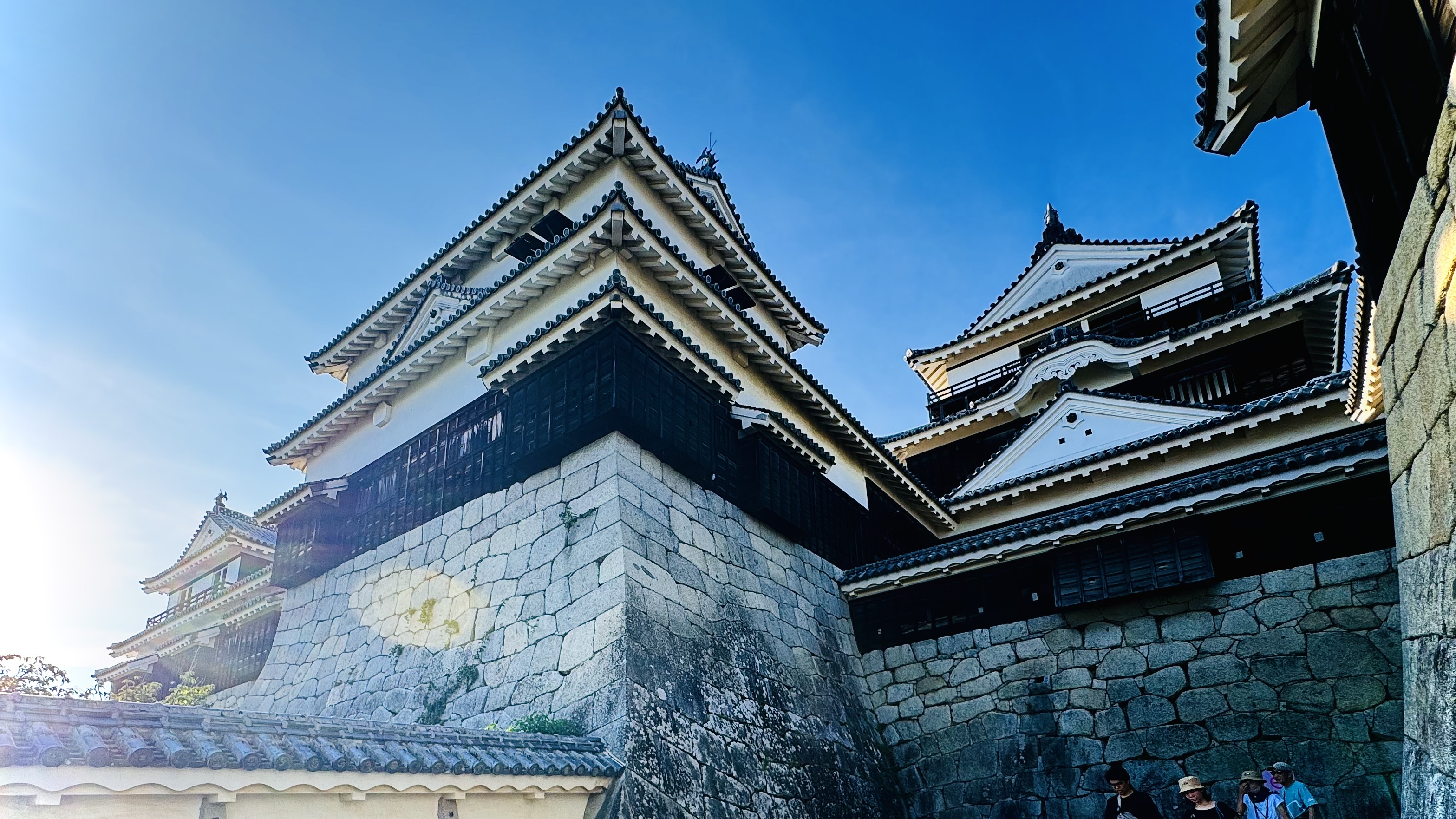
Perched high on Mount Katsuyama in Ehime Prefecture, Matsuyama Castle is one of Japan’s most beautiful and historically significant castles. Built in the early 17th century, the castle has survived fires, political change, and even war. Today it stands as a symbol of the cultural and historical heritage of the region.

For visitors exploring Shikoku, Matsuyama Castle offers more than scenic views. It tells stories of feudal governance, artistic culture, and the lives of individuals who shaped Japan’s history—including legendary swordsmith Takahashi Sadatsugu.
This article explores the castle’s history, the feudal lords who ruled it, and the cultural legacy surrounding it.
The Origins of Matsuyama Castle
Matsuyama Castle was built in 1603 on Mount Katsuyama overlooking the city of Matsuyama. The project began under the warlord Kato Yoshiaki, a powerful feudal lord who had supported Tokugawa Ieyasu during the establishment of the Tokugawa government. Construction of the castle took more than two decades. By 1627, just before the castle was fully completed, Kato Yoshiaki was transferred to another domain in Aizu. After his departure, the castle passed through several rulers until it came under the control of the Matsudaira family, relatives of the Tokugawa clan. The Matsudaira clan governed Matsuyama for more than 200 years, guiding the domain through the long period of peace known as the Edo period.
The Era of the Matsudaira Lords
One of the most important periods in the castle’s history began when Matsudaira Sadayuki took control of the domain in 1635. Under his leadership, the castle tower (tenshu) was reconstructed and the administration of the domain was reorganized. Over the following generations, the Matsudaira lords ruled Matsuyama and worked to strengthen both the castle and the surrounding city. Among these rulers was Matsudaira Sadanaga, who became lord of the castle in 1662. Sadanaga was known for his interest in culture and governance. He established a fish market in Mitsu to support local commerce and also restored important religious sites such as Isaniwa Shrine and Anumi Shrine. His peaceful rule reflected his personality. Sadanaga had a strong interest in renga, a traditional Japanese collaborative poetry form where several poets link verses together to create a single poem. This artistic pursuit reflected the cultural flowering of the domain during this time. The next lord, Matsudaira Sadanao, reorganized the castle’s administrative structure. He moved the main government offices to the San-no-maru (third bailey), while the Ni-no-maru (second bailey) became a residence for retirement. Sadanao also attempted financial reforms. Facing unstable tax revenues caused by unpredictable harvests, he introduced domain currency and revised the taxation system in order to stabilize the domain’s economy.
Disaster: Lightning and Fire
Despite the relative stability of the Edo period, Matsuyama Castle experienced several devastating disasters. In 1732, a severe famine struck the region during the rule of Matsudaira Sadahide, causing thousands of deaths due to starvation. Another crisis occurred in 1741, when farmers rose in protest over food shortages during the rule of Matsudaira Sadataka. The most dramatic disaster came in 1784 during the rule of Matsudaira Sadakuni. On the night of January 1st, lightning struck the castle. The main tower and the great hall were destroyed by fire, and flames raged through the complex until early morning. At the time, Lord Sadakuni was bedridden with illness. He was evacuated to a nearby temple for safety while the fire consumed the castle buildings. Recognizing the importance of the castle, Sadakuni immediately requested permission from the shogunate in Edo (present-day Tokyo) to rebuild the structure. Approval was granted later that same year. However, rebuilding such a large castle required enormous resources, and reconstruction would take decades.
Reform and Education in the Domain
In 1805, leadership of the domain passed to Matsudaira Sadanori. Sadanori believed that education was essential for strengthening the domain. He established a clan school in Edo to educate young samurai in both military and literary arts. These schools were important institutions in feudal Japan, training future administrators and warriors. His successor, Matsudaira Sadamichi, continued these reforms. Sadamichi expanded the number of students and promoted education as a way to strengthen samurai discipline and moral values. His policies aimed not only to teach knowledge but also to reform the government and restore traditional samurai ethics. These efforts proved important when Japan faced the dramatic political changes of the mid-19th century, culminating in the Meiji Restoration, which ended the rule of the shogunate.
Rebuilding the Castle Tower
The rebuilding of the castle tower was one of the most significant projects of the Matsuyama domain. In April 1820, Sadamichi began construction to fulfill the dying wish of his father, who hoped to see the castle tower restored. Unfortunately, the project faced repeated setbacks. After Sadamichi’s death, construction stopped temporarily. A fire at the building site also delayed progress. Finally, under Matsudaira Katsuyoshi, reconstruction resumed in the 19th century. The new main tower was completed in 1854, almost seventy years after the original tower had been destroyed by lightning.
The tower that visitors see today dates from this reconstruction period.
